
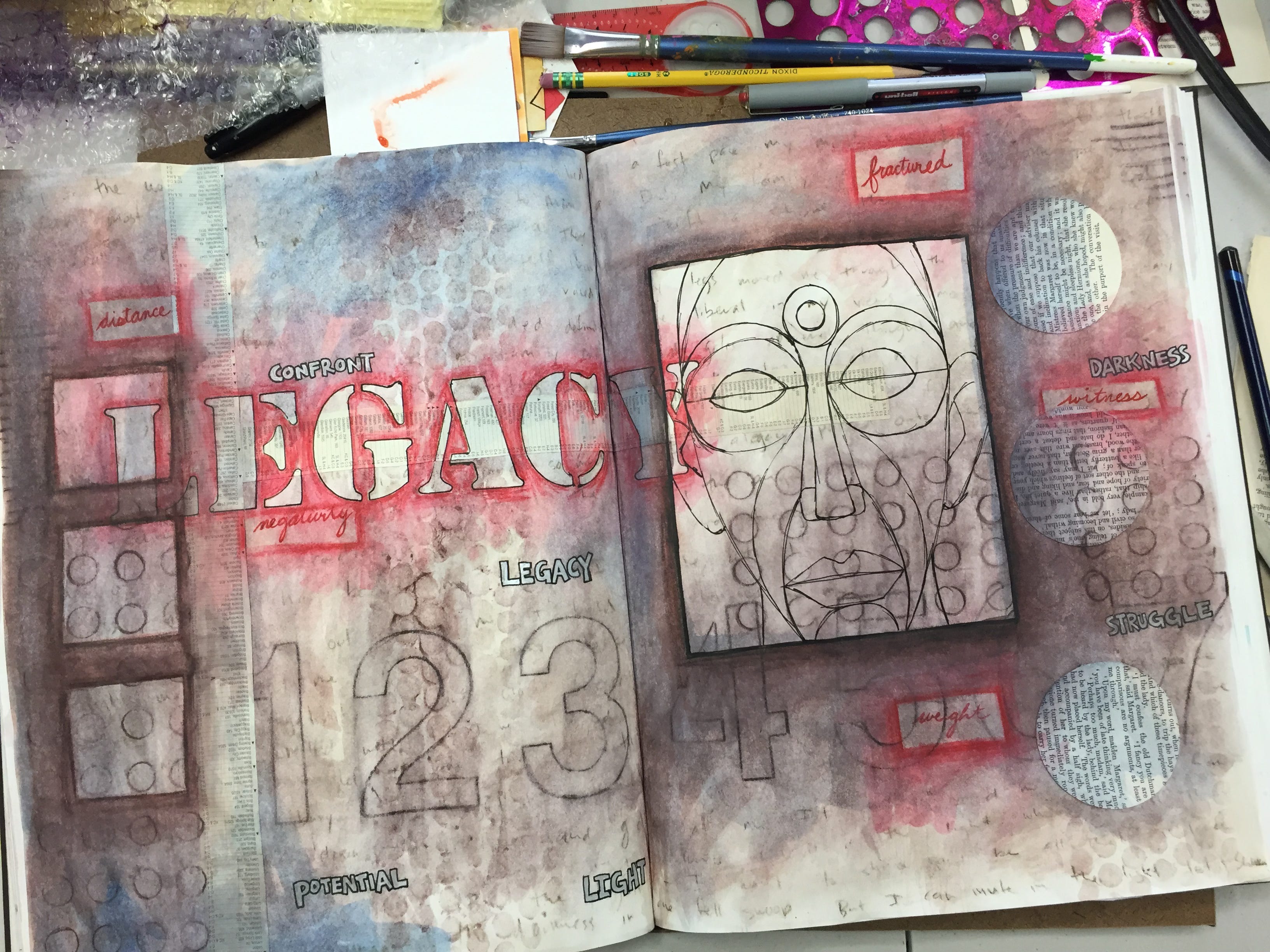
Although I often focus on artistic processes and allow ideas to develop and emerge as I play with materials, shapes, or colors, I also turn to words since they can play an important part in my creative process as well. It’s probably due to my long visual journaling practice where words, images, colors, and materials all mix and mingle. I’ve previous shared stream of consciousness writing and how I use the writing to look for words and phrases that can spark ideas, but the fact is you can use someone else’s writing as well. Now I’m not advocating that you copy someone else’s work and pass it as your own. However, picking out random words from a newspaper, dictionary, or book can be a great way to spark an idea.
I will warn you that this idea is a bit less structured than most of the Creative Spark Plugs that I’ve shared so far since it doesn’t give you specific materials or specific things to make. However, if you can allow yourself to be open to the uncertainty, you may find that this can spark you in ways that the others haven’t.
What you need:
Some source of text—a book, a newspaper, a magazine, a website, or an article.
Your chosen medium—if you’re a writer, then write. If you’re a painter, then paint. If you want to try something new, then try something new. (See this is where the less structured bit comes in.)
The Process:
The process is quite straight forward—randomly pick a word from the text. Don’t skim the writing, just pick a random word. I like to close my eyes and place my finger down randomly. Unfortunately, you may do this and pick a word that doesn’t do much to spark an idea like “the,” “and,” or “up.” So I like to look close by to see if there is a word that sparks me. If I don’t see something, I look a bit further out onto the page, and if I need to, I turn the page or find different text and repeat the process. Just be careful that you’re not using this as an excuse to dismiss words and ideas that you don’t like. You can spend a lot of time picking the right “random” word and not really do anything with it.
One thing that you may want to consider in choosing your random word is the source. If you pick a highly technical article or book, you’re going to encounter very specific and technical language, which may or may not be something that you can work with. So, by considering your source, you can up your odds of finding a juicy word that’s going to quickly spark ideas for you. But, it may be worth the challenge of picking a source that is a bit more confounding for you.
Once you have your chosen word (or words—who says that you can’t pick 4 or 5 words and let them spark off of each other), allow the word(s) to sit with you for a moment or two and begin creating.
If you’re stuck for what to do next, here are a few suggestions:
Write: I often go back to that stream of consciousness writing and use my chosen word as the prompt. You can explore the word and see where the stream will take you.
Make a List: Brainstorming a list of words and ideas that get conjured in your mind about your chosen word can be just the thing to spark a direction for you to go.
Sketch: Often the chosen word will spark a very clear image, so doodle, draw, or sketch the mental image. If you’re a writer, do a quick written sketch describing the image you see in your mind.
Percolate: It can be hard to dive straight into making something specific for the chosen word, so sometimes, you just want to put the idea in the back of your mind and allow it percolate. I love doing this by working on some artistic activity in my visual journal where I don’t have to engage my whole conscious mind. If I add some watercolor to my journal pages, doodle random lines and shapes in blank spaces, or cut and glue down random pieces of paper, I leave room for my unconscious to turn over the idea. It’s like when I mow the yard or wash the dishes and an idea seems to strike out of nowhere. But I’ve come to understand that the idea has just been turning over and over in the back of my mind.
Of course there are many other ways of working with your chosen word, so allow the word to spark ideas, modes of working, and bigger themes to explore. There is no right or wrong way of doing this. You just want to use your word as a source of inspiration.
I will note that with a simple internet search you can find a number of random word generators. These can be a great substitute for an actual text, and some of them allow you to set the number of words, so you can end up with 3 or 5 or even 10 different random words. You can pick one or use all of them. But I’ll ague that there’s just something about the tactile nature of picking up a book or newspaper and pointing randomly to a spot on the page. But try either or both, and see where it can take you.
Thank you so much for reading. This is a free publication, and I try to offer something each week. If you find what I share valuable and would like to keep it going please buy my books, hire me to speak, take a workshop, or become a paid subscriber. Paid subscribers have access to a monthly virtual meet up where we meet as a creative community to create together, talk, and share. I’d love to have you as part of that community. Become a paid subscriber:
Happy Creating!
Eric
PS. My next virtual meet-up for paid subscribers will be this Saturday, September 13th, from noon to 2pm Eastern! If you’d like to join in, become a paid subscriber, or register for individual meet-ups on my website.